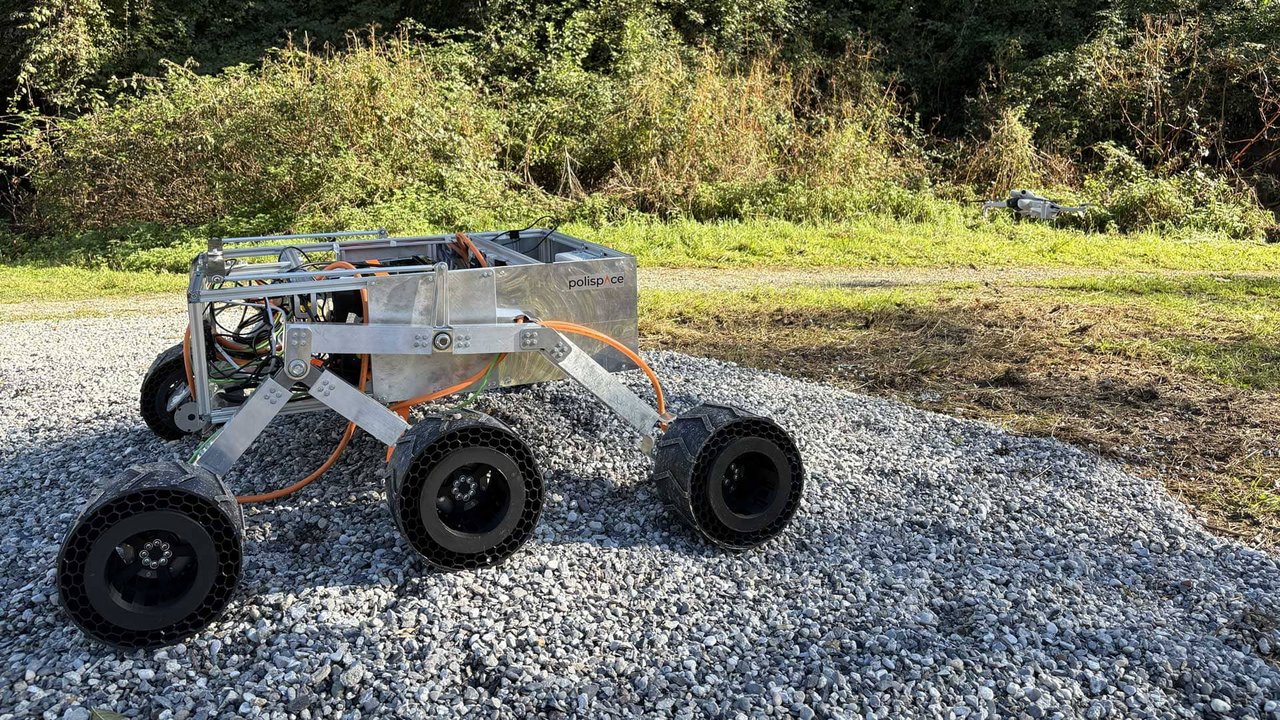

European Rover Challenge is an international space robotics competition. Each competing team must design and develop the structure and systems of a rover, program the software – from the management of engines and sensors to the creation of the path planning and computer vision algorithm – carry out performance tests, analyze the necessary budget and explore new technologies and strategies to improve. During the finals, the teams show off the rover's capabilities on terrain similar to that of Mars.
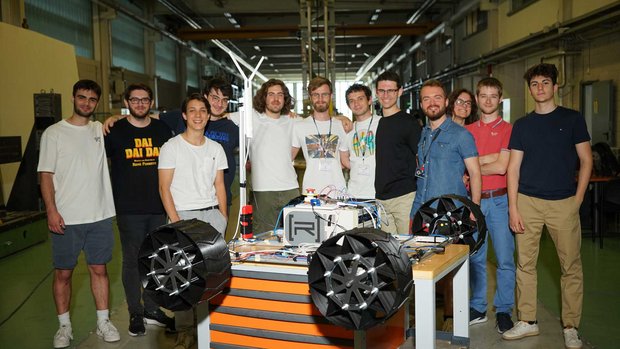
The Polimi Team
[R]overTech is a team of 65 students from the programme in Space, Aerospace, Mechanical, Computer Science, Automation and Materials Engineering, with Prof. Mauro Massari as the project contact person. The working group is divided into four departments: Structures, Software, EEPS and Science. Born in 2023, it participates in the European Rover Challenge for the first time in 2024.
Let's get to know Rovertech
WHO IS IN THE TEAM?
Our team is made up of students from Politecnico di Milano enrolled in various engineering degree programs, both bachelor’s and master’s, particularly Aerospace Engineering, Mechanical Engineering, Automation Engineering, Physics, and Environmental Engineering.
We should also mention the students enrolled in Engineering of Computing Systems, who take care of the entire software side, which is essential for the automation of the rover prototype.
WHEN WAS THE TEAM FOUNDED AND HOW HAS IT EVOLVED OVER TIME?
The Rovertech team was founded in 2023 during our first year of our bachelor’s degree at Politecnico di Milano. During one lecture, we were getting a bit bored studying only theoretical concepts and realized we were missing the practical side. We felt a strong desire to build something tangible and apply the theory we had learned in class. From that moment on, we started meeting and organizing brainstorming sessions with other classmates to understand what project could bring us together. Eventually, we formed a rover team after realizing that Politecnico did not yet have a student group participating in this type of competition.
At the beginning, we were quite inexperienced in building prototypes, so the team went through many changes. For example, at first we had only four departments, with one of them handling multiple aspects simultaneously, such as both the mechanical and electronic components of the robotic arm structure. Over the years, we realized that the best approach was to clearly separate the areas of expertise: creating a dedicated mechanical department, a dedicated electronics department, and leaving the software team to manage the payloads while maintaining a clear distinction between all departments. In this way, roles and responsibilities do not overlap.
HOW MANY PEOPLE ARE IN THE TEAM?
Currently, the Rovertech team is composed of 62 members. We started with just two people, then grew to 17 during the first year, and now we are finally 62 students divided into five departments.
WHAT IS THE TEAM’S MAIN ACTIVITY AND HOW DOES THE WORK TAKE PLACE DURING THE YEAR?
Our main objective as a team is to participate in the European Rover Challenge, a competition held every year in Poland that brings together more than 120 universities from around the world. The goal of the event is to build a rover similar to those used on Mars, the Moon, or other planets for surface exploration. This prototype must be fully autonomous. A typical week for us includes a working session where all departments meet to work together, share updates, and collaborate on different payloads, not just within individual departments. In addition, each department holds its own meetings in our laboratory on the Milano Bovisa campus. Finally, the team leaders organize several meetings to manage the team, deadlines, and overall coordination.
WHAT IS THE SECRET THAT KEEPS THE TEAM TOGETHER?
Keeping a team of 62 people together is not easy, especially since we are all students, so it is something we are continuously working on. However, what has helped us the most over the years is creating working moments that involve all departments, allowing every team member to actively contribute to the project. Equally important are the moments outside the university environment: creating social occasions where we meet even after general meetings, for example by going out to eat together. These moments help us take a break from work and are key to effective collaboration between departments and people coming from different backgrounds.
Another important aspect is communication between departments. We try to keep it fast and, especially in technical contexts, avoid unnecessarily complicated or uncommon terminology.
WHAT IS THE FURTHEST CITY YOU HAVE EVER COMPETED IN?
The European Rover Challenge takes place every year in Kraków, Poland.
ARE THERE ANY FUN OR UNEXPECTED STORIES YOU REMEMBER?
For our first prototype, we created a wheel using a 3D printer and a flexible material. Since we had no prior experience with the behavior of this material, we designed a “minimal” wheel that was not realistic in terms of how it would behave on the prototype. As a result, we didn’t fully exploit the material’s potential. The wheel, which was supposed to support a load of 15 kg, actually deformed under its own weight. When we realized it wouldn’t work, we stopped the print halfway and immediately began studying the design of a new wheel.
After several attempts, we finally arrived at a working design, which is the one we currently use. The great advantage of having several 3D printers and the possibility of rapid prototyping is that we can run multiple tests and experiment with different technologies until we reach an optimal solution.
The greatest satisfaction is seeing something that started from an idea take shape and actually work after all the days spent designing and developing it, overcoming all the challenges encountered along the way.
WHAT ARE THE NEXT GOALS?
Our main short-term goal is to participate in the next European Rover Challenge, which will take place in September. Looking further ahead, we would also like to participate in other rover competitions, such as the University Rover Challenge, which is held in the United States. This event is even more international, with universities from all over the world taking part.
WHY SHOULD SOMEONE JOIN THE TEAM?
One important reason is the opportunity to carry out practical activities and gain hands-on experience. The project covers many aspects that are also relevant in the professional world.
Another reason is the satisfaction of seeing something physical come to life from an initial idea. Even getting an excellent grade on an exam is not the same as seeing a real system working thanks to an idea you helped develop.
It is also valuable to work in an international team with students from all over the world. This environment allows you to exchange ideas with people coming from very different backgrounds and share different ways of working.